


Dehradun: ARUNODAY TIMES
Chief Minister Pushkar Singh Dhami on Sunday chaired a meeting with Principal Scientific Adviser to the Prime Minister’s Office (PMO) Prof. Ajay Sood and experts from various scientific and technical institutions at the Chief Minister’s residence.

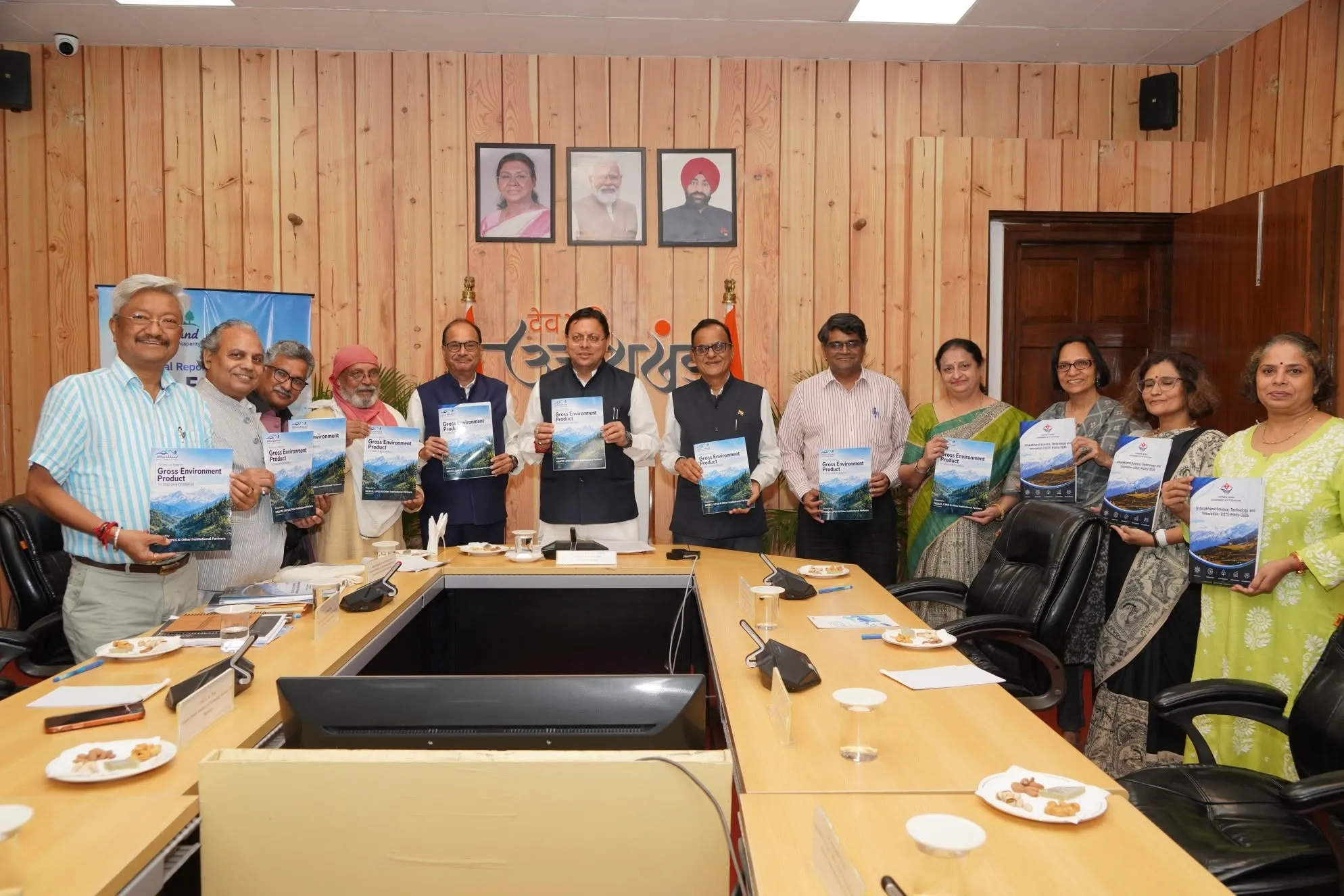
During the meeting, the Chief Minister unveiled the Uttarakhand Science, Technology and Innovation Policy-2026. The Gross Environment Product (GEP) Technical Reports for 2023-24 and financial year 2024-25 were also released.
The meeting witnessed detailed discussions on various aspects of the GEP reports, including the economic valuation of Uttarakhand’s natural resources and environmental services. Experts shared their views on the significance of forests, water resources, biodiversity, soil conservation, carbon sequestration and other ecosystem services, along with their scientific and economic assessment.
CM Dhami directed officials to include carbon credits in the Uttarakhand Science, Technology and Innovation Policy-2026. He also called for making water harvesting simpler and more accessible for the general public. 
The Chief Minister said the GEP framework can help scientifically and economically assess the contribution of the state’s natural and environmental wealth. Such an assessment, he said, can help in better understanding the importance of environmental resources and incorporating their contribution into development plans and policies.
Emphasising Uttarakhand’s unique geographical and environmental conditions, Dhami said the state should develop a GEP model tailored to its local resources, requirements and ecological characteristics. He sought technical guidance and support from experts and scientific institutions in developing such a framework. 
The Chief Minister stressed the need to strike a balance between development and environmental conservation. He said development planning must take into account the capacity of natural resources, environmental sensitivity and local conditions.
Dhami further said that efforts related to carbon sequestration, forest conservation, natural resource management and environmental services should be supported by scientific and technological interventions. He also emphasised linking natural resource conservation with community participation and livelihood opportunities.
During the meeting, experts discussed the scientific foundation of GEP, collection and analysis of environmental data, and the potential application of the framework in a Himalayan state like Uttarakhand.
Focus on Himalayan Challenges
Unveiling the Science, Technology and Innovation Policy-2026, CM Dhami said Uttarakhand’s distinctive geographical and socio-economic conditions require innovative and region-specific solutions. He stressed the need to use science, technology and innovation to address the challenges faced by the Himalayan state.
The policy seeks to promote region-specific research and development, identify emerging areas of science and technology, and encourage scientific and technological interventions for the state’s overall development.
The policy also focuses on strengthening local research and development activities and ensuring effective dissemination of their outcomes, with the objective of contributing to economic growth and improving the quality of life.
Key priority areas identified under the policy include glaciology, natural disaster management, energy, water resources, agriculture, healthcare, educational challenges in mountainous areas, migration, skill development, entrepreneurship, intellectual property rights protection and innovation.
The meeting was attended by Prof. Shiv Kumar, Chief Executive Officer of the Anusandhan National Research Foundation (ANRF); senior scientist Dr. Parminder Main; Dr. Anil Prakash Joshi, founder of the Himalayan Environmental Studies and Conservation Organisation (HESCO); Prof. K.K. Pant, Director of IIT Roorkee; Prof. Durgesh Pant, Director General of the Uttarakhand State Council for Science and Technology (UCOST); academician Dr. Reema Pant; UCOST’s Surendra Singh Manral; and Dr. Vipin Sati, among other experts.

