


Supreme Court Upholds SIR Process, Big Relief for Election Commission
Court Says No Flaw in Procedure, Voter List Revision to Continue Across the Country
New Delhi: ARUNODAY TIMES
In a major decision on the controversial Special Intensive Revision (SIR) of electoral rolls, the Supreme Court on Wednesday gave significant relief to the Election Commission of India (ECI). The apex court stated that there was no flaw in the SIR process and that it falls within the powers of the Election Commission. The court also clarified that the process will continue across the country as before.
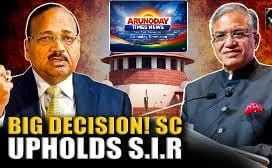
A bench comprising Chief Justice of India (CJI) Suryakant and Justice Joymalya Bagchi observed during the hearing that the Election Commission had followed the complete legal procedure. The court emphasized that free and fair elections are the backbone of democracy and maintaining the purity of voter lists is the responsibility of the Commission.
The Supreme Court further stated that the Election Commission has the authority to refuse inclusion of a person’s name in the electoral roll after due verification. The bench held that the Commission’s actions were within the framework of the Constitution and the law.
Several petitions had challenged the legal validity of the SIR exercise, arguing that the process exceeded the powers granted to the Election Commission under Article 326 of the Constitution and the Representation of the People Act, 1950.
The controversy mainly centered around the requirement that voters whose names were not present in the 2002 voter list — or the 2003 voter list in some states — would need to establish an ancestral link with a person whose name existed in those electoral rolls. Petitioners argued that this condition could disenfranchise genuine voters, especially migrants, poor citizens and backward communities who may not possess such old documents.
During the proceedings, the Supreme Court also issued interim directions aimed at increasing transparency and reducing difficulties faced by voters in different states and Union Territories affected by the SIR process. Initially, the Election Commission had identified 11 documents for verification, but later, following the court’s directions, Aadhaar was also included as an additional document.
The issue first arose when the Election Commission decided to conduct SIR in Bihar in June last year. The exercise was later extended to several other states and Union Territories, including West Bengal, Kerala and Tamil Nadu.
Defending the process before the court, the Election Commission argued that the revision exercise was aimed at ensuring the purity of electoral rolls and preventing duplication or inclusion of ineligible voters.
After an extensive hearing, the bench led by CJI Suryakant had reserved its verdict on January 29, which was finally delivered on Wednesday.